The term Cesta Roman carries historical depth and cultural richness that continues to attract curiosity today. Whether explored through ancient history, linguistic roots, or cultural symbolism, Cesta Roman reflects a blend of tradition and legacy. In this detailed guide, we will examine the origins of Cesta Roman, its historical background, cultural importance, architectural connections, and modern interpretations. By the end of this article, you will gain a complete understanding of why Cesta Roman remains a topic of growing interest.
What Is Cesta Roman
Cesta Roman can be interpreted as a phrase rooted in classical heritage. The word “cesta” in several European languages refers to a road or path, while “Roman” naturally connects to the ancient Roman civilization. When combined, Cesta Roman symbolizes the Roman road or pathway, which historically represented infrastructure, expansion, and connectivity across vast territories.
The Roman Empire was famous for constructing durable and strategically planned road networks. These roads were not merely transportation routes; they were symbols of power, governance, and unity. Therefore, the concept of Cesta Roman can be understood as a representation of Roman engineering excellence and cultural integration.
Historical Background of Cesta Roman
Roman Infrastructure and Cesta Roman
The Roman Empire developed one of the most advanced road systems in ancient history. The idea behind Cesta Roman aligns closely with these historic routes that connected cities, provinces, and trade centers.
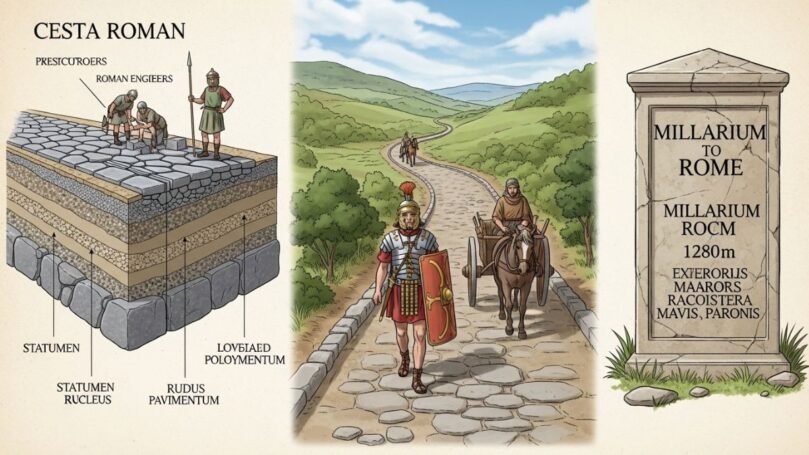
Roman roads were built with multiple layers of stone and gravel to ensure durability. Many of these roads still exist today, showcasing the engineering brilliance of Roman architects. The development of Cesta Roman-type pathways helped facilitate trade, military movement, and communication across Europe, North Africa, and parts of Asia.
Expansion of the Roman Empire Through Cesta Roman
The expansion of Roman territory relied heavily on its road network. These roads allowed armies to move efficiently and maintain control over distant regions. Cesta Roman symbolizes this expansion strategy that contributed to Rome’s dominance for centuries.
Below is a simplified table explaining the structure of a typical Roman road:
| Layer Name | Material Used | Purpose |
|---|---|---|
| Statumen | Large Stones | Foundation support |
| Rudus | Crushed Stones | Stability |
| Nucleus | Sand and Gravel | Smooth surface base |
| Summum Dorsum | Paving Stones | Final walking/driving surface |
This structured approach demonstrates why Roman roads lasted for generations.
Cultural Importance of Cesta Roman
Symbol of Connectivity
Cesta Roman is not only about physical roads but also about connection. Roman roads linked cultures, languages, and traditions. Trade flourished because merchants could travel safely between regions.
This connectivity allowed Roman law, art, architecture, and governance systems to spread across continents. As a result, many modern European cities still reflect Roman influence in their planning and infrastructure.
Architectural Influence of Cesta Roman
Roman engineering techniques influenced bridges, aqueducts, and highways that followed. Cesta Roman stands as a symbol of how structured planning can impact civilization.
Modern highways are often inspired by the Roman grid system. Urban planning concepts, such as straight streets intersecting at right angles, have roots in Roman city design.
Cesta Roman in Modern Context
Tourism and Historical Routes
Today, many ancient Roman roads are popular tourist destinations. Travelers explore these historical paths to experience the legacy of Roman engineering.
For example, several preserved Roman roads across Europe attract historians and tourists alike. Walking along these paths offers a glimpse into the daily life of ancient civilizations.
Here is a table showing modern relevance areas connected to Cesta Roman:
| Area of Relevance | Description |
|---|---|
| Tourism | Historical exploration sites |
| Education | Study of ancient engineering |
| Urban Planning | Inspiration for modern city layouts |
| Cultural Heritage | Preservation of Roman history |
Educational Significance of Cesta Roman
Students studying history often analyze Roman roads to understand empire-building strategies. Cesta Roman serves as a practical example of how infrastructure supports political and economic growth.
Educational institutions frequently reference Roman road systems when teaching civil engineering and architecture principles. The precision and durability of these constructions remain impressive even by today’s standards.
Engineering Excellence Behind Cesta Roman
The engineering behind Cesta Romans was far ahead of its time. Romans carefully selected locations for their roads, considering terrain, drainage, and long-term durability.
They built roads in straight lines whenever possible, cutting through hills and constructing bridges over rivers. This direct route planning minimized travel time and strengthened military logistics.
Drainage Systems in Cesta Roman
One key reason Roman roads survived centuries was effective drainage. Roads were slightly curved in the center, allowing rainwater to flow off the sides. This prevented erosion and structural damage.
The planning and detail involved in creating Cesta Roman-type routes highlight the advanced knowledge Romans possessed in construction techniques.
Economic Impact of Cesta Roman
Cesta Romans contributed significantly to economic development within the Roman Empire. Trade routes allowed goods such as wine, olive oil, grain, and textiles to circulate freely.
Merchants benefited from faster and safer travel. Markets expanded beyond local communities, and economic prosperity increased across regions connected by Roman roads.
Without such infrastructure, large-scale trade would have been nearly impossible in ancient times.
Social Influence of Cesta Roman
Beyond economics and military use, Cesta Romans played a role in social integration. Travelers carried ideas, languages, and traditions along these roads.
This exchange led to cultural blending. Roman customs merged with local traditions, creating diverse yet unified communities under Roman rule.
Such integration laid the groundwork for many European societies as we know them today.
Preservation Efforts Related to Cesta Roman
Many governments and historical organizations work to preserve ancient Roman roads. These preservation efforts aim to protect cultural heritage and educate future generations.
Restoration projects often involve careful excavation and structural reinforcement. Modern materials may be added discreetly to prevent further deterioration while maintaining historical authenticity.
Preserved Cesta Romans pathways serve as outdoor museums, allowing visitors to connect with ancient history directly.
Why Cesta Roman Still Matters Today
Cesta Roman represents more than an ancient road system. It symbolizes strategic thinking, innovation, and long-term planning. The Roman approach to infrastructure demonstrates how thoughtful design can shape civilizations for centuries.
Modern societies continue to rely on strong transportation networks. Highways, rail systems, and urban grids all echo the foundational principles first demonstrated by Roman engineers.
The lessons learned from Cesta Romans emphasize durability, connectivity, and forward-thinking development.
Key Features of Cesta Roman
Structured Construction
Roman roads followed a layered construction method ensuring long-term stability.
Strategic Placement
Routes were carefully selected for efficiency and accessibility.
Long-Term Durability
Many Roman roads remain intact after thousands of years.
Cultural Expansion
These roads enabled cultural and political influence across continents.
Comparing Cesta Roman to Modern Roads
While modern roads use advanced materials such as asphalt and concrete, the fundamental principles remain similar.
| Feature | Cesta Roman | Modern Roads |
|---|---|---|
| Materials | Stone and Gravel | Asphalt and Concrete |
| Drainage System | Elevated Center | Engineered Drainage |
| Purpose | Military and Trade | Transportation and Commerce |
| Durability | Centuries | Decades |
The comparison highlights how Roman innovations continue to influence current infrastructure systems.
Conclusion
Cesta Romans stands as a timeless example of innovation, planning, and cultural integration. From its historical roots in the Roman Empire to its influence on modern infrastructure, the concept continues to inspire historians, engineers, and travelers.
Understanding Cesta Roman allows us to appreciate how ancient civilizations laid the foundation for today’s connected world. Its legacy reminds us that strong infrastructure is essential for growth, unity, and progress.
As we move forward in developing smarter cities and transportation systems, the lessons drawn from Cesta Romans remain as relevant as ever.